Marriage, as a Matter of Course
In The Symposium, written by the ancient Greek philosopher Plato, Aristophanes tells an allegorical story to explain why humans long for love and union. He says that in the beginning, humans were not single beings as they are now.
[1]There were three types: male–male (children of the sun), female–female (children of the earth), and male–female (children of the moon). Each original human had four arms, four legs, two faces facing opposite directions on one head, and two sets of genitals. They were fast and powerful, and even attempted to challenge the gods. Zeus, wanting to weaken them without destroying humanity—since that would leave no one to offer sacrifices—came up with a solution: he split them in half with lightning, turning each into two separate individuals. After being split, each person felt deep loss and emptiness and began searching for their missing half. When they found each other again, they felt strong attraction and love, longing to become whole once more. This, Aristophanes said, is the origin of human love.
When I was twenty-one, I was married once, to a girl who was too beautiful and too intelligent. In that marriage, I did not love her, and she did not love me. We were young, and we both longed for love, but we fell in love with the wrong people. So instead of the beauty of love, what we felt first was pain.
That year, she had a major fight with her family. She wanted to anger them at any cost, and she chose to do so by marrying me. She was an American citizen of Taiwanese descent. Knowing that I was going to the United States for six months, she asked if I wanted to marry her. We could get married once in Taiwan, and after I arrived in the U.S., she would fly over and we would marry again in Las Vegas. That way, I could get a green card and leave my life in Taiwan behind.
My mother had always told me that marriage was just a piece of paper, so in my mind it did not seem like a big deal. I agreed. I also casually told my mother, which shocked her. She told me I should at least buy the girl a ring as a symbol of commitment. I sold some stocks and chose a Cartier ring for her.
In my experience, marriage is not necessarily a symbol of happiness. There is a saying that “marriage is the grave of love.[2]” Being together does not always make people stronger. I have seen many people severely wounded in marriage. Perhaps they treated marriage as a solution to emotional problems. This meaningless marriage, however, was the opposite for me—it was a form of relief. Telling others that I was married meant that I was already settled, no longer fighting on the battlefield of courtship, no longer getting hurt, and no longer having to face how unsuccessful I was in love.
Naturally, she never flew to the United States. We never married in Las Vegas, and I never got a green card. In the end, I did not come to like America either, so I felt no regret. When I returned to Taiwan, we divorced quickly and stopped being friends. I rarely think of her now. But I often take out the wedding photo I keep in my wallet and joke with others, saying, “I never had love, but I did have a marriage.
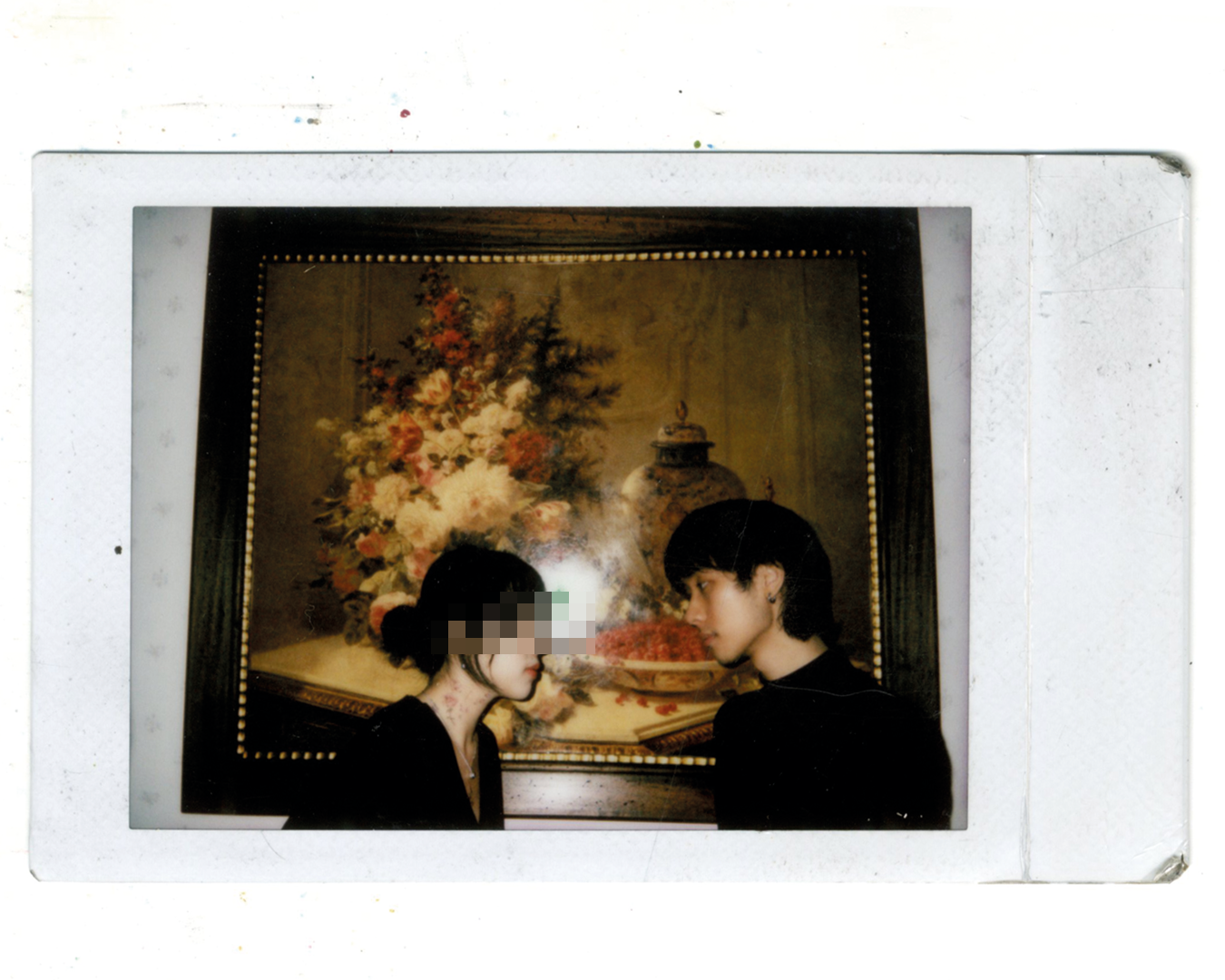
A photo from the day we officially registered our marriage.
[1]“Next, gentlemen, the original human beings were spherical in shape, with rounded backs and sides. They had four arms and four legs, two identical faces set on a circular neck supporting a round head. The two faces looked in opposite directions, and they had four ears and a single set of genitals; all the other parts of their bodies were similarly doubled. They walked upright as we do now and could move forward or backward at will. When they wished to run fast, they moved by rolling forward like wheels; with their limbs extended, they had, in effect, eight legs, and thus could roll along at remarkable speed.”
[2]Le mariage est le tombeau de l'amour.
The one who loves me and the one I love are not the same.
“No matter how poor your conditions are, there will always be someone who loves you. No matter how good your conditions are, there will always be someone who does not love you.” — Half a Lifelong Romance, Eileen Chang
I often feel angry at the gym. When I see men and women with perfect bodies, I always feel that life comes easily to them, and that love has never really been a problem for them. A friend of mine has a boss who is exactly that type—he looks like a model from a Zara advertisement. His biggest problem in life is that every woman who approaches him only wants to have sex with him and does not want to give sincere love. I envy how easily they can obtain what I have spent my entire life searching for. I don’t understand what I did wrong. I go to the gym every day. I study hard, work hard, donate money, and do good deeds. Why is it that I still can’t find someone I love who also loves me?
I once heard a story. In Taiwan’s mainstream education system, exam results almost equal a student’s value. In an advanced academic class[1], there was a girl who ranked second and had a crush on the boy who ranked first. She believed that as long as she studied hard and entered the most prestigious university together with him, she would be worthy of him, they would be together, and live happily ever after. In the end, they did get into the same university, but the boy did not fall in love with her. Instead, he fell in love with another girl who had not even graduated from a technical college[2]. In love, it seems very difficult to judge the two sides of the equation.
When I was seventeen or eighteen, carefree and reckless, I did not plunge into a passionate, dramatic romance. Year after year of being single, as I became more independent, relationships only became more difficult. Being in a relationship is like merging two lives into one. I have tried my best to live a good life on my own, and at this point I ask myself: “If another person enters my life, will it become better, or worse?” Over the years, I have not lacked people who pursued me, and my desire for love still exists. However, as I grow older, there are many practical realities I must consider. Being in a relationship does not mean I don’t have to go to work tomorrow; mortgages and student loans still have to be paid. I am increasingly unsure whether the future will really be like a fairy tale, where someone appears and I sacrifice myself for love[3], or whether reality is simply that people gradually grow numb to their longing for love and become accustomed to loneliness. I don’t know.
“Only the young are free. As one grows older, one sinks inch by inch into the mire of habit. Not marrying, not having children, avoiding a fixed life—it is all useless. The lonely have their own mire.” — When We Were Young, Eileen Chang
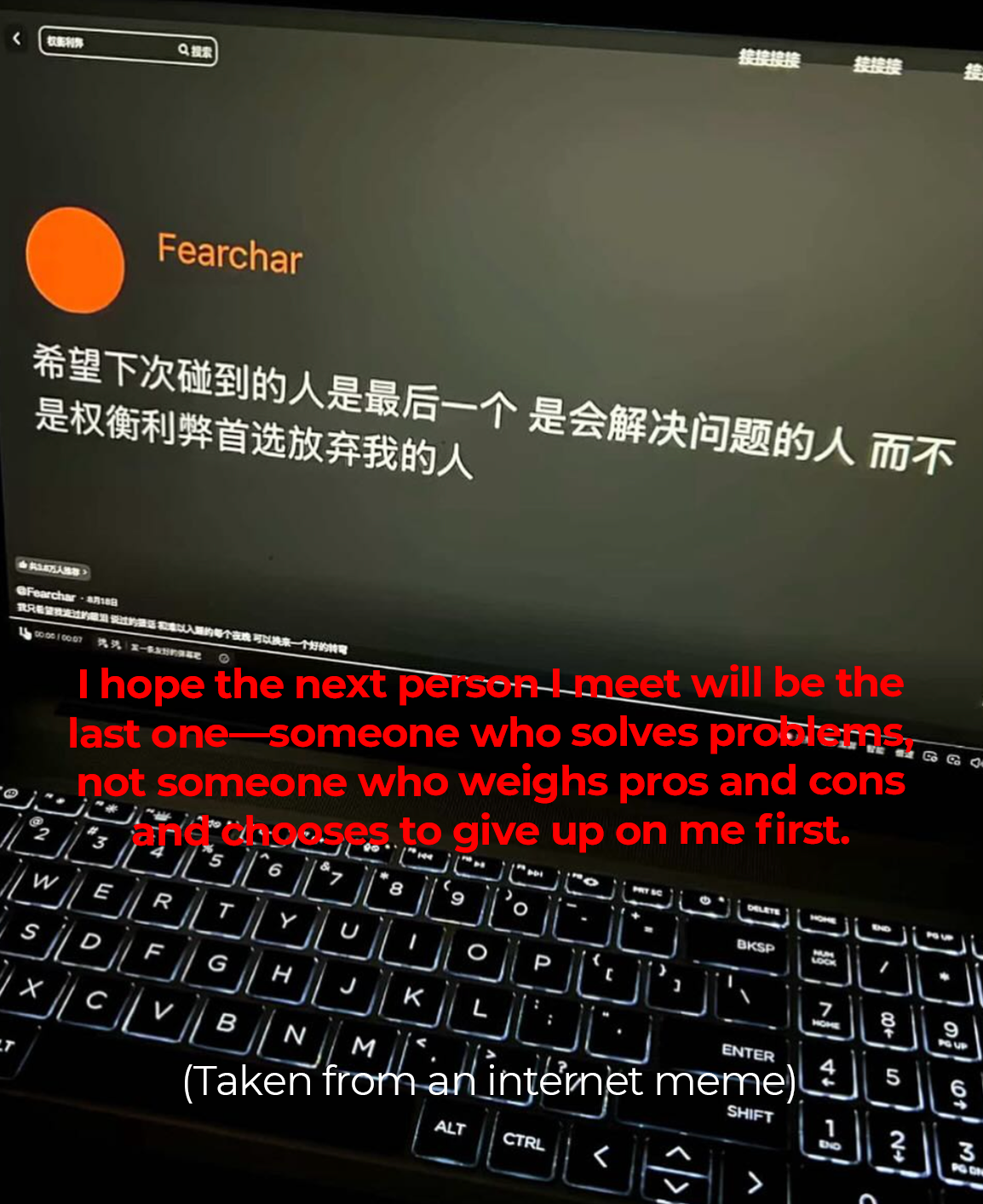
[1] In Taiwan, students take entrance examinations in junior high school and are assigned to different senior high schools based on their scores. Many high schools further divide students into separate classes, and those with higher academic performance—aiming for admission to top universities—are placed into so-called “college-preparatory classes,” where they receive focused training from the school.
[2] Four-year technical colleges and two-year junior colleges usually place less emphasis on academic scores and prioritize students’ future vocational and technical skills instead.
[3] I once heard someone use Sartre’s saying, “Hell is other people” (L'enfer, c'est les autres), to describe the state of being in love. People are supposed to live for themselves; however, in the blindness of love, individuals often neglect their own existence and even willingly devote their lives and sense of meaning to another person.
A Seashell and a Copied Love
When I was nineteen, I was diagnosed with Asperger’s syndrome. It explained why I had always felt out of place among others. I felt relieved, but also angry about the injustices I had endured in the past. Before that, I was like a robot hiding in human society, doing everything I could to imitate others’ behavior in order not to be discovered. Whenever I told people I had Asperger’s, they usually showed a look of disbelief. I would tell them, “I don’t really feel anything about what you’re going through, but I will pretend to cry for you.” Even after saying this, some people still didn’t believe me, which meant I had acted well enough. I heard that people with mild symptoms like mine often have similar experiences. Because we are naturally sensitive and intelligent, able to imitate and predict others’ behavior, we often appear more socially skilled than average, but without true empathy. When faced with situations that require a genuine emotional response, we crash—such as love.
In the winter before the COVID-19 pandemic, I went with a group of my hippie friends from Taiwan to a hippie music festival in Chiang Mai, Thailand. Among my friends was a very beautiful girl, and as soon as we arrived, she quickly attracted a lot of male attention. A French boy approached us. While chatting and laughing with us, he took out a box full of seashells. He said he had collected them from beaches around the world and asked each of us to choose one as a souvenir. What he really wanted was to use the shells to express his affection for that girl, while the rest of us were just awkward extras. Still, I had to admire his way of pleasing women. In the following days, whenever he saw me, he would ask where she was, how she was doing that day. I could clearly feel his strong love for her. Perhaps out of curiosity about the feeling of loving and being loved, I felt inexplicably moved, even though I knew those feelings were not directed at me.
After that, I imitated him and began collecting seashells from beaches around the world. I collected many, but never gave a single one away. I didn’t know who to give them to. Even if there were someone, these shells could not represent my true feelings; they were only copied emotions. Eventually, I stopped collecting them and threw them all away at once, keeping only the one the French boy had given me.
At the end of the festival, the French boy invited us to travel with him through Thailand to India, but we did not go. The beautiful girl also did not choose any of the many men; instead, she fell in love with another girl and lived for several months in another province of Thailand. Even a sincere love can eventually turn into nothing, as if it never began.
Death Is Getting Closer, and I’m Still Single
Another friend of mine died. He was very handsome, not even thirty. I think it was probably suicide. We only talked a few times, not a lot, but I know he was a good person. In the past two or three years, many people around me have died—old and young. At my age, there shouldn’t be so many people leaving one after another. I keep thinking: we’re in our youth. We should be spending life freely, wasting time boldly. How can this be happening? I used to believe life was a long road, that people walk from the start to the end. But I didn’t realize someone can slip at a corner, fall into a deep abyss, and break into pieces. Death always pulls people tight, because we all feel the same sadness and the same fear.
This year, it’s not only deaths that break hearts. Many couples also broke up after years together. I have a few female friends who, in their confused early twenties, chose men who could give them stability. After many years, these girls became women.[1] They realized they were not as helpless as they thought. Their sense of security didn’t have to come from a man. And then they reached the age when people usually get married. If they didn’t stop now, the rest of their life might be wasted on someone they couldn’t accept. So they broke up.
Even if they don’t regret the choice, they still spend a long time and a lot of energy adjusting to single life.
I know how anxiety comes with time. I asked them, “Do you want to find the next one quickly? I’ve heard some people use a new relationship to avoid the pain of the last one.” They all said no. They wanted to rest first. I know that is a brave decision. I also know people who can’t accept being single. Their gap between relationships is less than two weeks. That actually worries me. With divorce rates so high now, it’s hard to guarantee someone will stay with you for life. The recklessness of youth will be paid back in old age, with interest. Even if you’re lucky enough to find someone to stay with you until the end, you still don’t know who will die first. (Maybe I’m just jealous of happy people, so I sound this pessimistic.)
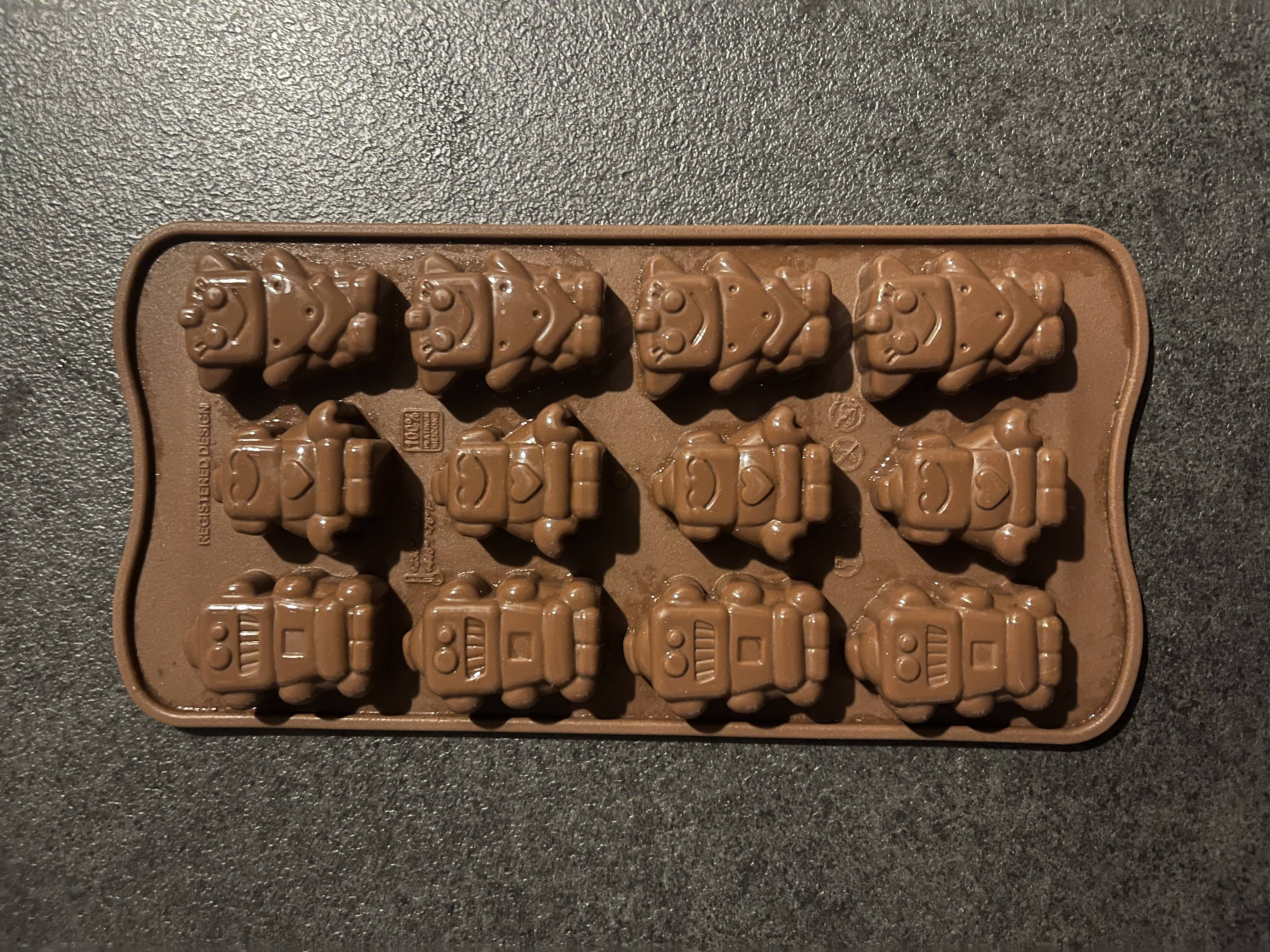
The day after I got the death message was Valentine’s Day. That morning, I received a “Happy Valentine’s Day” text from a friend who also broke up this year. I thought, “Fuck. Another year.” Every Valentine’s Day makes me very anxious, especially this year, when so many people broke up. I always feel like other people’s partners come and go, but I’m still standing in the same place. I remember before I started college, I bought a very expensive chocolate mold. I thought I could use it to make chocolate for my partner on Valentine’s Day. But it has been sitting in my cabinet, collecting dust. I have never used it. I even brought it from Taiwan to the Netherlands. Every Valentine’s Day, I take it out, wash it, and put it back. Until now, it still looks brand new.
Two years ago, I made a bet. I bet with a friend on whether I would stop being single by last year’s Valentine’s Day. Of course, I still didn’t. But she broke up with the man she thought she would marry. And by this Valentine’s Day, she was still getting used to being single. This kind of bet is hard to win. Almost no one around me has ever won it. To me, it’s hard to fall in love, hard to keep a relationship, and hard to spend Valentine’s Day alone. In a world that has love, everything is hard. It gets harder every year. Why is love so hard? And death is getting closer, but I still have no idea what to do about any of this.
[1] Recommended song: “About the Little Bear”
Do Not Be Afraid, It’s Just That Half My Face Was Eaten by a Cat
2026 Apr 29
I am a Christian. I pray often, and God often says to me, “Do not be afraid.” At first, I was confused. I am someone who almost never has nightmares, and I thought there was nothing in this world for me to fear. But thinking back now, I find myself rather pitiful, because I did not even realize that I was trembling.
In the summer of 2024, I had a minor surgery. I went through it alone. I asked my family to come and take care of me, but they all found reasons not to. I was furious. My sister said to me, “You’re already an adult. No one is obligated to take care of you.” In that moment, I realized that the abundant love I had felt in childhood had suddenly become very thin after I grew up.
Lying in the hospital bed, I felt fear like never before. I was so afraid that after I was put under anesthesia, I might never wake up again. Thankfully, the surgery was successful. It was just that when I woke up, no one was beside me.
At that time, a piece of news kept echoing in my mind: an elderly woman who lived alone died at home, and for a long time no one discovered her. When she was finally found, half of her face had already been eaten by her cat.
A person, alone, for a whole lifetime, with no responsibilities and no attachments—only to have half her face eaten by a cat after death. Maybe that is not so bad either.
After that surgery, I no longer allowed myself to collapse. Not only because no one would catch me, but because I could not even catch myself. I could not bear the sound of my own breaking. I know that I have always survived by chance, within the mercy of God.
Jeremiah 29:11: “For I know the thoughts that I think toward you, says the Lord, thoughts of peace and not of evil, to give you a future and a hope.”
May God have mercy on me and grant me peace.
But I always feel that I am not used to a peaceful life. Whenever life begins to feel stable, I start waiting uneasily for something bad to happen. Over time, it seems I have become unable to imagine that I could be happy, or become a happy person.
Subscribe to my newsletter
New writing, exhibitions, and works.